Let’s build a life you are excited to wake up to, together.
Clarity isn’t something you wait for — it’s something you build.
(I learned this the hard way, after tracking my happiness every fifteen minutes for like… a concerning amount of time.)
This isn’t therapy, and it’s not a course where I tell you to journal more and drink water.
It’s the actual process I built from almost a decade of accidentally running experiments on my own life — condensed so you don’t have to spend ten years doing what I did.
By the end, you’ll know exactly what you should be doing to build a life you are excited to wake up to every day.

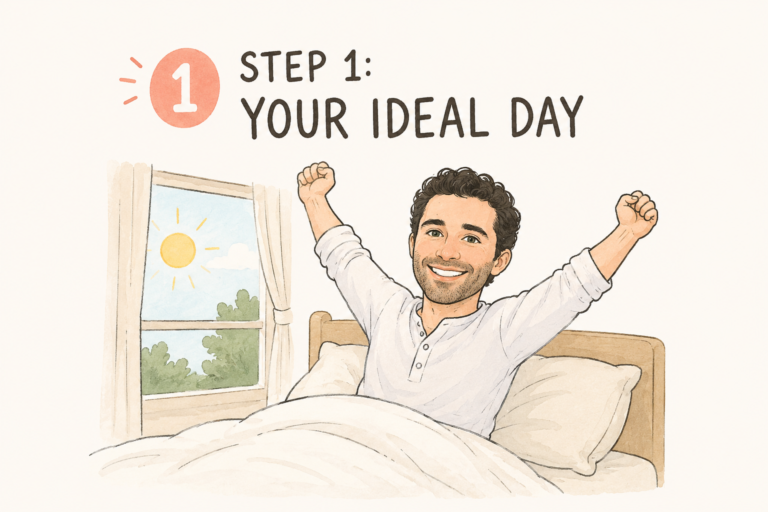
STEP 1: YOUR IDEAL DAY
You’ve probably done this exercise before.
It probably didn’t land.
That’s because you did it from your head — and your head is full of what you think you should want.
But the thing is, your left-brain took over.
This is your logical side telling you what you think you want.
It’s hijacking what you truly want, deep-down.
By focusing on the sensory input throuhgout the day, and having someone guide you through it, you can fully relax your left-brain and let your right brain take over.
What temperature is the room when you wake up? What kind of floor do you have? Do you hear any noises outside while you’re lying in bed. Your phone is vibrating, who’s calling?
All of it — specific enough that by the end you have a real blueprint, not a mood board.
(This is the one where people go *oh.* A lot.)
STEP 2: YOUR BEST MONTH

Before we build forward, we look back.
We walk you through a month-by-month review of your recent past — your camera roll, your memories, a few targeted questions — to find the stretches when you actually felt like yourself.
Not your best day.
Your best month.
Because when you zoom out that far, the noise drops away and the real patterns show up.
What were you doing? Who were you with? What was different?
That’s your actual data. And it tells you more about what you need than any personality test ever will.
STEP 3: YOUR VALUES
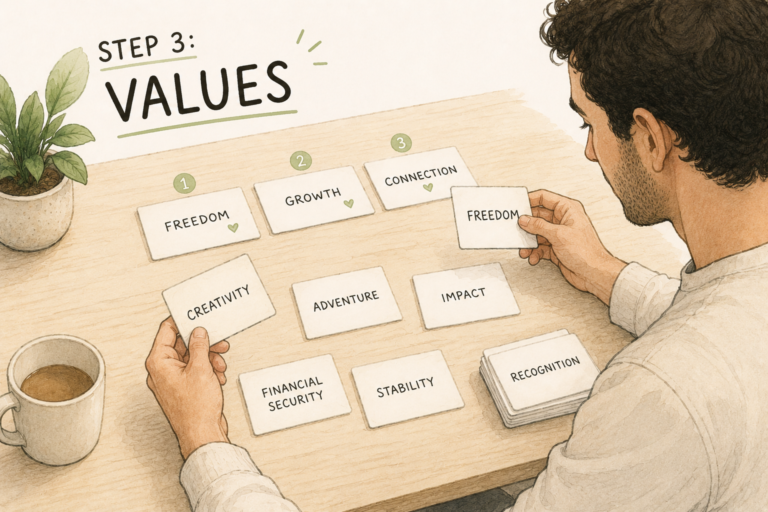
Not a list of words you’re supposed to care about.
An actual ranking — done with physical cards, in real time — of what matters most to you right now, in this season of your life.
What you resist putting at the top is usually as revealing as what you do.
This becomes the filter for everything else. Every decision, every tradeoff, every design choice — it runs through this list.
STEP 4: YOUR BASELINE
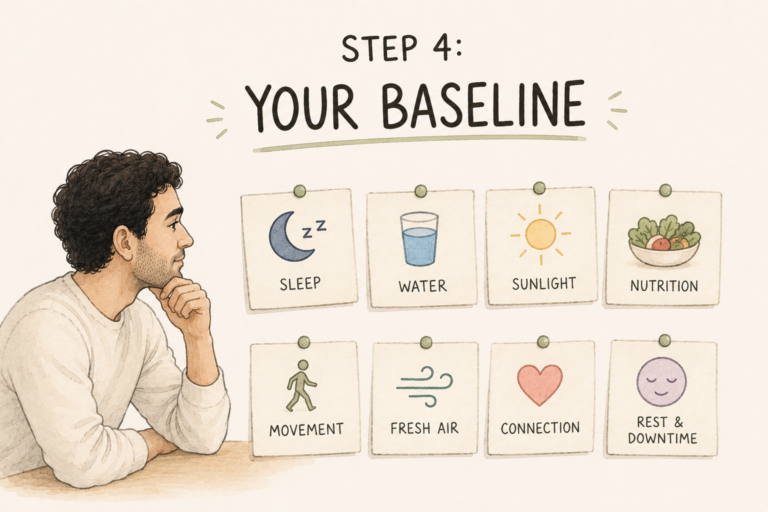
Here’s something most happiness advice gets completely wrong: there’s a difference between getting *to* neutral and getting *above* it.
And if your baseline is being dragged below neutral by sleep deprivation, sitting inside the entire day, or just your nervous system running in survival mode, let’s see if there’s any patterns of things that might be easily fixed.
You fix the floor first.
But if you’re already doing all of that and still feel kind of flat?
That’s most of the people I work with.
And that’s exactly what the rest of this is built to solve.
STEP 5: YOU’RE THE DIRECTOR NOW
This is where it all clicks.
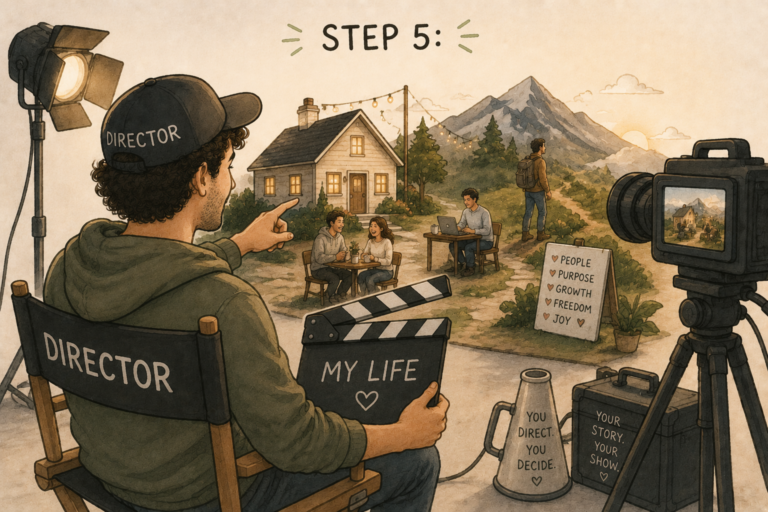
Using your ideal day, your best-month patterns, and your values — we actually design the conditions of your life.
Not in theory. In practice.
You pick the characters — who gets your time and energy.
You pick the plot — what you’re building toward and why.
You pick the soundtrack — how you move through your days emotionally.
You pick the novelty — what makes *this* season different from the last.
Your favorite show isn’t someone else’s life.
Yours shouldn’t be either.—Most people spend years collecting advice, trying habits, and waiting for clarity to show up on its own.
It doesn’t show up. You build it.
STEP 6: Revisit, Reflect, Repeat
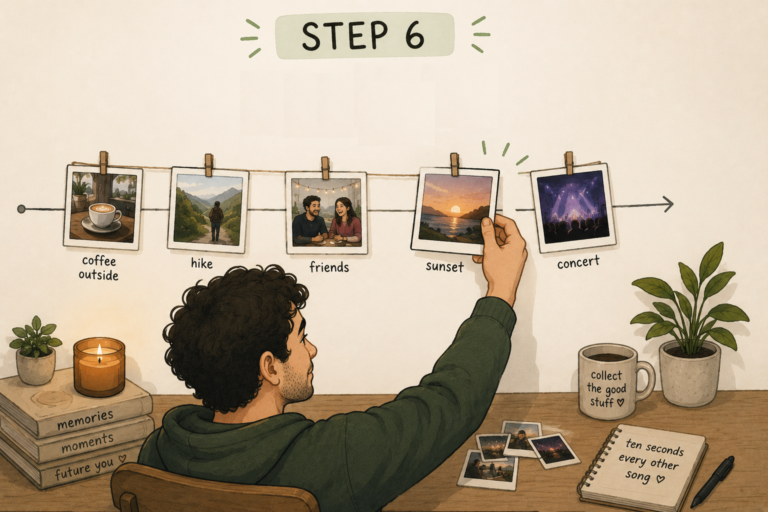
Building a life you love requires one thing most people never do:Pay attention.
Not every fifteen minutes (been there). Just enough to notice what actually makes your life feel alive.
Photos. Videos. Voice memos.
Whatever works for you.
Because your memories lie. And what’s the point of building a life you love if you can’t remember it?
I think about it like concerts. Record the whole thing and you miss it. Record none of it and you forget it. You need to find your ten seconds every other song.
You’re not documenting your life for data. You’re documenting it so future you has something real to learn from.
I spent a decade building this system for myself.